

January 26, 2026 | 3.5 Minute Read
Last week, I spoke with a fellow investor who was considering selling two of his long-term Section 8 rentals. I know these properties well—I sold them to him about five years ago.
The good news? The properties have performed exactly as intended. Same tenants since purchase. Minimal maintenance issues. Stable cash flow.

Then I asked a simple question:
“What are the rents today?”
His answer surprised me.
They were exactly the same as five years ago—$850 and $900.
No increase. In five years.
How does that happen?
Let me explain.
Where Property Management Companies Fail
Property management companies love turnkey investors. When a property is sold with a tenant already in place, the hard work is done. The unit is cash flowing from day one, and the management company steps in and immediately collects their 8%–10% fee.
But this is where many of them fail owners.
When leases come up for renewal, rents often stay flat. Why? Because management companies are afraid of vacancy. A rent increase introduces risk: a tenant may leave, the unit may need repairs, and the company would have to coordinate turnover, re-lease the property, and onboard a new tenant.
Keeping the existing tenant at below-market rent is easier. It also keeps vacancy rates low, which management companies can then use to market themselves to new clients.
The problem is obvious: the owner absorbs the long-term cost.
How Section 8 Rent Increases Actually Work
With Section 8 tenants, rent increases are not automatic. You must complete a rent increase request and submit it within 60 days of lease renewal, along with proper notice to the tenant.
It’s a simple process, but there are real considerations:
If it’s the first renewal year, increases are rarely approved. Typically, you need to wait until year two.
If the tenant pays a portion of the rent, an increase may raise their monthly obligation. For some tenants, even an extra $100 can feel overwhelming.
On rare occasions, a tenant may say they can’t afford the increase and threaten to move. In practice, moving costs often exceed any savings from a lower rent elsewhere—but tenants don’t always think in those terms.
My Strategy for Maximizing Section 8 Rents
For existing tenants, I submit rent increase requests supported by strong comps and notify the tenant properly. Approval usually takes about four weeks, and roughly 80% of the time, the increase is approved.
If the request is denied, I evaluate two options:
Keep the tenant at below-market rent
This preserves cash flow, avoids vacancy, and eliminates turnover costs.Vacate and re-lease at market rent
This creates short-term pain—vacancy, lost rent, and repair costs—but may make sense long term.
I only choose to vacate when market rent is at least 30% higher than the current rent.
My Strategy to Max Rents with Section 8
When showing a property to a Section 8 applicant who wants to move forward, I ask two questions:
What is the maximum rent allowed on your voucher?
Are you responsible for any portion of the rent?
For example, if a property is advertised at $1,300 and the applicant’s voucher allows up to $1,500, most property managers submit the rent at $1,300.
I don’t.
I submit at the maximum allowed—often plus a small buffer. If the tenant pays a portion, I ensure their monthly income is at least three times their rent portion.
More often than not, the approved rent comes back higher than the advertised price.
Incoming Tenants for February
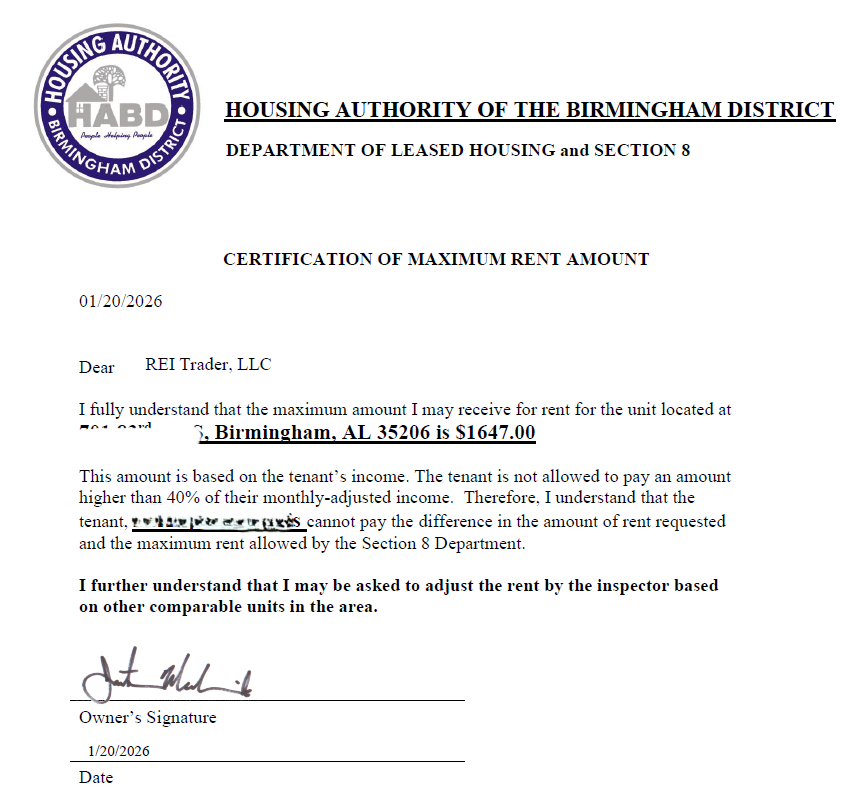
This was a property we acquired a few months ago and running it through the BRRRR strategy.
4 bed / 2 bath
Advertised rent: $1,595
Voucher max: $1,650
Submitted rent: $1,695
Approved rent: $1,647

Existing Property (Tenant Turnover)
3 bed / 1 bath
Previous rent: $900 (tenant lived there for five years)
Rent increase request to $1,200: Denied
Market rent: $1,300+
We did not renew the lease and the tenant vacated on October 31.
Costs incurred:
Lost rent (3 months): $2,700
Turnover repairs: $3,000
Total cost: $5,700
New lease:
Advertised rent: $1,300
Voucher max: $1,495
Submitted rent: $1,500
Approved rent: $1,422

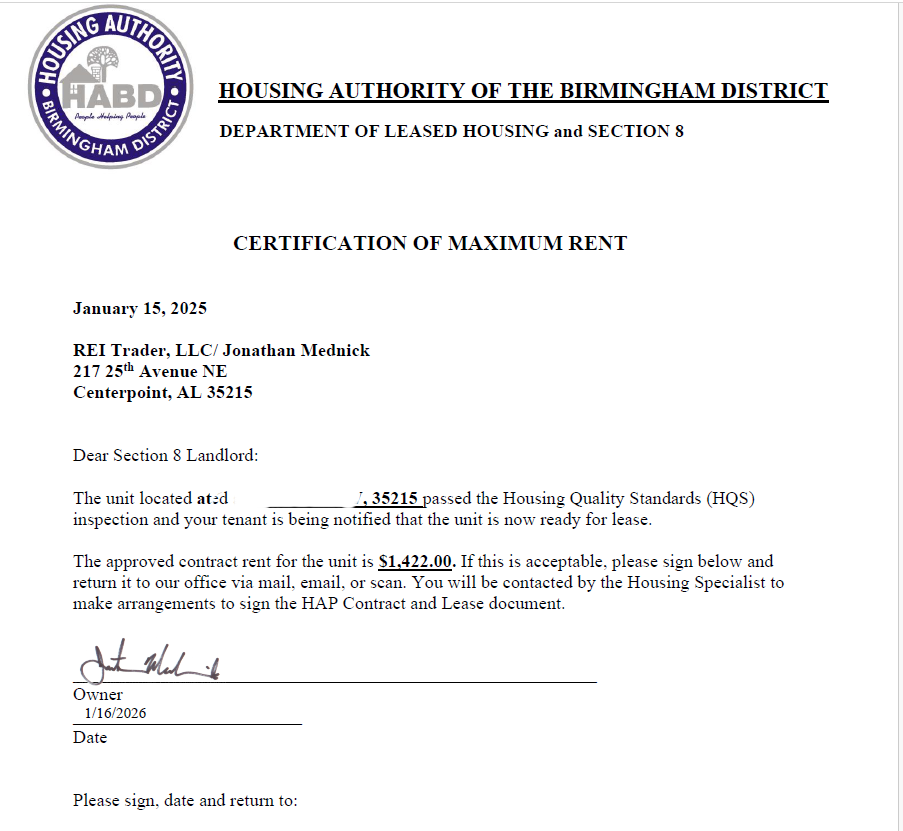
That’s a $522+ monthly increase compared to the previous tenant. The $5,700 in turnover costs are recouped in roughly 11 months.
Was This the Right Move?
Some would say no.
Strategically, I say yes.
Not only is the property producing significantly more cash flow today, but the higher rent strengthens future refinancing. Higher income supports DSCR requirements and allows for a larger cash-out at max LTV.
Just as important, our Section 8 tenants stay six years or longer. I expect the same with the new tenant, this time at market rent.
Section 8 properties are not “set it and forget it.” The biggest mistake investors make is allowing rents to stagnate out of fear of vacancy. With the right process—understanding vouchers, submitting rent increases correctly, and making strategic turnover decisions—Section 8 can produce consistent, growing cash flow while strengthening long-term equity and refinance potential.
If you get any pushback from your property management when it comes to increasing rents, it’s time to shop for a new property manager.