

April 27, 2026 | 3 Minute Read
Most investors purchase properties specifically to operate as short-term rentals (STRs). We took a different approach. We converted several of our long-term rentals (LTRs) into STRs.


At one point, we operated as many as 16 STRs. However, not all of them performed as projected. The underperforming properties were either converted back to long-term rentals, sold to turnkey investors, or sold on the retail market to owner-occupants.
LTR vs. STR: Two Very Different Products
Converting an LTR into an STR isn’t just a change in strategy—it’s a completely different product. Renovating for a long-term tenant is far less intensive than preparing a property to operate like a small hotel, where guests expect higher-end finishes, better design, and a full suite of amenities.
What Does It Cost to Convert?
On average, our conversions look like this:
- $30,000 for renovations
- $10,000 for furnishing and setup
- Total investment: $40,000 per property
.
Across our STR portfolio, we average about $1,500/month in net profit per property, which puts our break-even timeline at approximately 26–27 months (about 2.2 years).
Current Portfolio Snapshot
We currently operate nine STRs:
- Five properties have been active for over three years and have fully recouped their conversion costs.
- One property is approaching the two-year mark and is nearly at break-even.
- One property, launched in January 2026, had conversion costs of $31,480.87. We avoided furnishing costs by reusing inventory from previous STRs. At an average of $1,500/month net, we expect to break even in about 21 months.
.
That leaves two properties that I personally own, which required significantly higher investment.
Why I Converted My Two Properties
Quick sidebar: I converted these properties out of frustration with long-term tenants. Both properties suffered significant damage, and one situation escalated into a lawsuit after a tenant’s dogs—prohibited by the lease—attacked a sheriff. Thankfully the $250,000 settlement was covered by insurance.
Basically, I had nothing but crap tenants.
That was the tipping point.
But, still. This was a risk. The worst outcome would be spending this capital and seeing less cash flow (or none at all in some months) than keeping them as long term rentals.
If I failed, what would be my exit strategy?
Would I convert them back to long term rentals?
Absolutely not.
When I transitioned these into STRs, I made a deliberate decision to go higher-end, investing well above our typical conversion budget.
If the STR strategy didn’t work, I was prepared to simply flip these properties to owner occupants, take a nice profit, and move on.
So, they were either going to be STR’s or retail flips.
It was go time. Let’s dig in.
THE VISTA
- Size: 1,800 sq. ft. | 4 bed / 2 bath / 2 living areas
- Renovation: $82,586.62
- Furnishing: $12,669.74
- Total Investment: $95,256.36
.
I launched this property in December 2022.
December 2022 – May 2026:
- Grossed: $175,042.13.
- Net: $84,085.09
- Profit: 48%
.
Here’s how it breaks down:

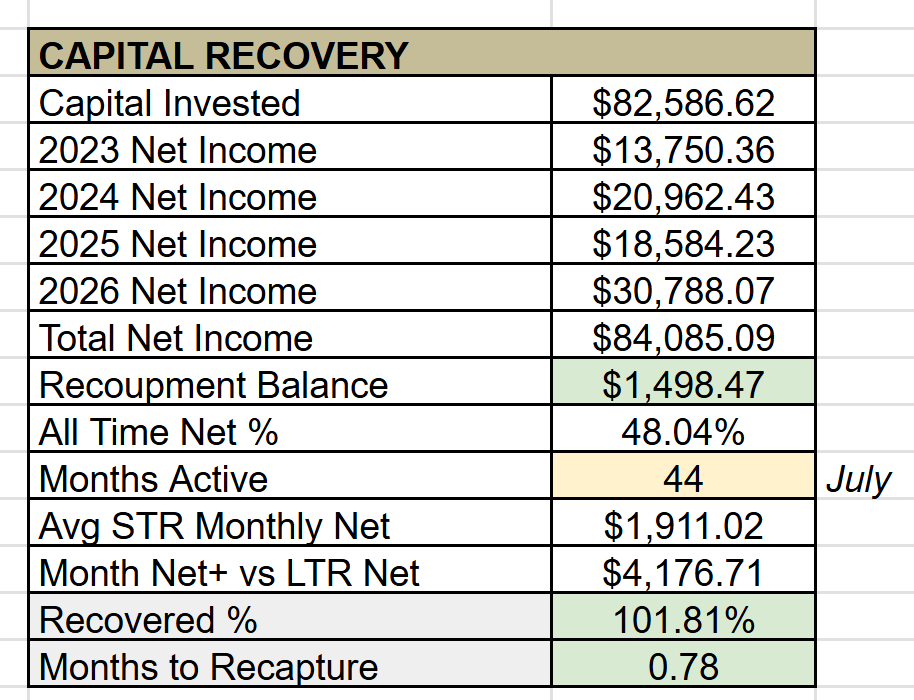
The first year showed lower profitability because I treated the furnishing cost as a 12-month recovery expense:
- $12,669.74 ÷ 12 = $1,055.81/month
.
I currently have a mid-term direct insurance booking at $5,750/month, running from December 2025 through July 2026 which is why the future income is included in the forecast. Most likely, the guest will extend into the Fall. She has been in the property now for five months but work on her home has yet to begin because of insurance and contractor delays.
At this pace, I will fully recover my total investment in 44 months (3 years, 8 months through July).
Since launch, the property has averaged:
- $1,911.02/month in net profit
.
Compared to its previous LTR performance of $450/month, that’s:
- 4.2X more cash flow
THE HILLTOP
- Size: 1,425 sq. ft. | 3 bed / 2 bath
- Renovation: $59,504.84
- Furnishing: $8,558.17
- Total Investment: $68,063.01
.
This property launched in May of 2023.
May 2023 – May 2026:
- Grossed: $122,620.67
- Net: $58,803.48
- Profit: 48%
.Here’s the numbers.

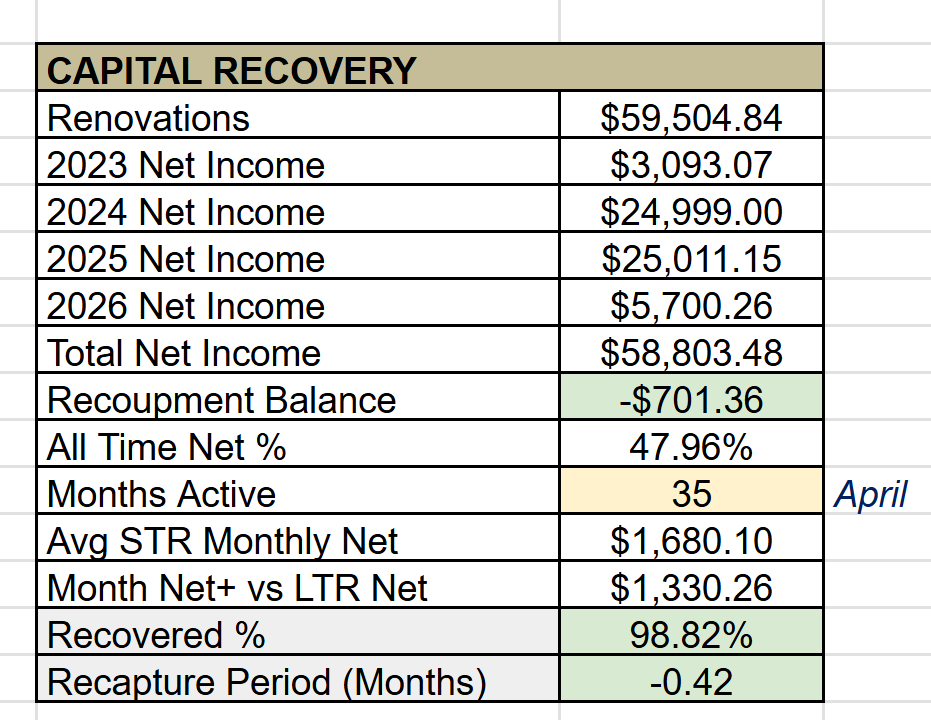
The first year was challenging. After allocating furnishing costs:
- $8,558.17 ÷ 12 = $713.18/month
.
The property was essentially break-even in year one due to inconsistent guest experiences and negative reviews, which impacted bookings.
Stabilization took time. I addressed the guest feedback, made improvements, and even delisted and created a new listing twice.
I will tell you that on more than one occasion, I wasn’t sure this property would succeed as a short term rental. I gave serious consideration to my secondary exit strategy of selling it retail.
I am glad I didn’t.
Now, approaching the three-year mark, I will fully recover my investment in early May. This is almost to the day when I first launched it 36 months (3 years) ago.
Current performance:
- $1,680.10/month net profit
.
Compared to $300/month as an LTR, that’s:
- 5.6X more cash flow
.
Was It Worth It?
- Total investment: $163,319.37
- Total YTD Gross: $297,662.80
- Total YTD Net: $142,888.57
- Profit Margin: 48%
.
Note: I am not including the $20,430.08 furniture costs in my total YTD date because that was an expense recouped monthly during the first year of operations.
And, the estimated projected 2026 revenue will be even better:
- Gross revenue: $111,431
- Net profit: $69,880.34
- Profit margin: 62.7%
.
If these properties were still long-term rentals:
- $750/month combined = $9,000/year
.
STR performance:
- $69,880.34 ÷ $9,000 = 7.76X higher income
.
But the biggest lesson is this:
Year one is all about stabilization. Converting a long-term rental into a short-term rental comes with very different expectations, and it took time for me to adjust because no amount of research fully prepares you for how different the product really is in practice.
I needed to shift from a long-term rental, hands-off mindset to a short-term rental, hospitality-focused, hands-on approach. It required a real paradigm shift in how I manage and think about a short term rental property.
And, you don’t fully understand the operational challenges and guest expectations until feedback is received. Fixing those issues often requires additional capital and time.
- Year 1: Stabilization and troubleshooting based on guest feedback
- Year 2: Optimization, improve processes, and upgrades
- Year 3+: Strong consistent cash flow through automating and streamlining systems
.
Today, both properties are performing at a level that far exceeds their long-term rental potential.
Still worth it? I Absolutely.