

February 23, 2026 | 3.5 Minute Read
By now, you know we operate nine successful short-term rentals. Our newest property, The Magnolia, had a slow January start — which was expected, as it’s historically our slowest month. But February, another typically soft month, rebounded strongly. We booked 17 nights and generated a net profit of $2,166.10.

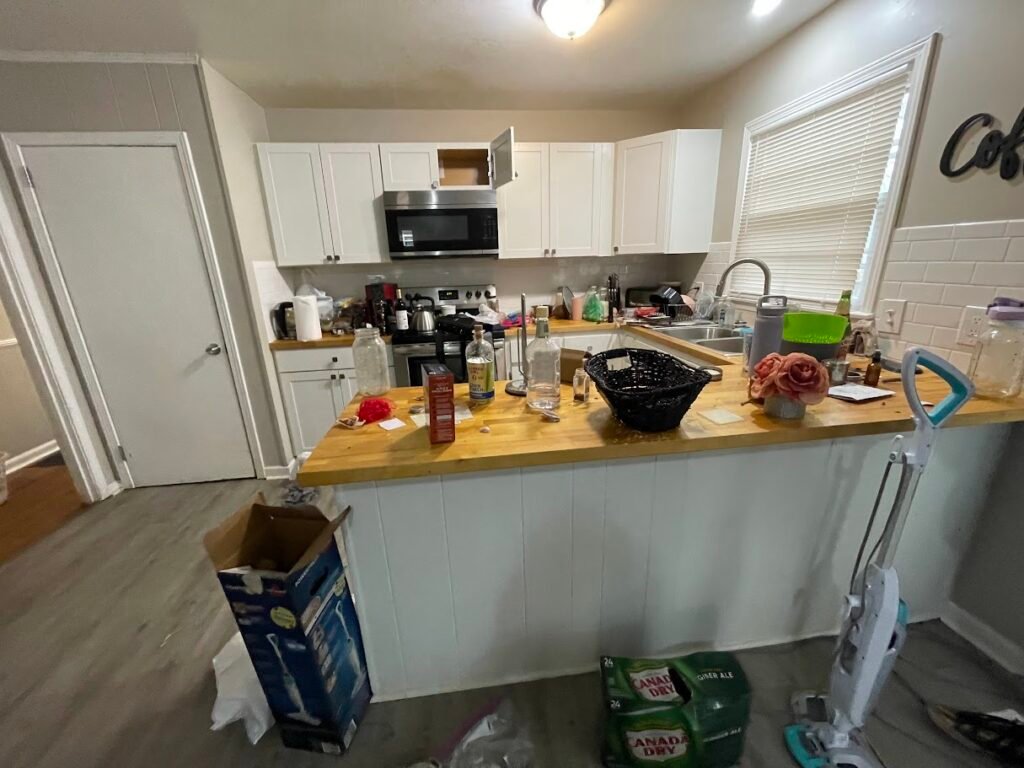
Our Strategy for Slow Season
Every Autumn, our goal is simple: secure mid-term bookings to carry us through December, January, and February.
A mid-term booking is a stay of 28 days or longer. In most cases, these guests are local homeowners displaced by damage — typically fire, storm, or water loss — and their housing is paid for by insurance.
Most of our mid-term leads come from relocation companies that work directly with insurance carriers. I maintain relationships with 22 relocation services and typically receive two to three placement requests per month.
The process generally works like this:
The relocation company submits a housing request.
We negotiate the monthly rate.
The insurance company reviews and approves.
The guest is offered the property.
If accepted, we schedule a showing.
The agreement is signed and payment is arranged.
There are additional administrative steps, but that’s the overview.
Why Mid-Term Rentals Are So Attractive
The income can be excellent:
- The monthly booking fee is between $4500 – $6,000.
- Guests stay several months (often 6+).
- No frequent turnover costs (cleaning, restocking, etc.).
- No vacancy gaps between bookings.
- Stable, predictable monthly revenue.
Here is two of our most recent mid-term bookings.
The Vista: A Mid-Term Win
The Vista came from a direct relocation service referral. The guest was displaced due to fire damage and moved in on November 28, 2025, at $5,750 per month.
The initial contract was three months, but repairs on their home have not yet begun, and they’ve indicated they will likely renew for another three months.
The property is averaging $4,240 net per month — exactly what mid-term strategy is designed to accomplish: stable cash flow during slow season.
The Argonne: They Trashed the House
The Argonne was also a relocation placement, but this one came through Airbnb at the request of the relocation company. The guest had tree damage to their home and moved in August 5, 2025.
They disclosed they had several dogs — four total — and said they would be crated indoors. Based on projected revenue, we accepted the risk.
They stayed 6½ months.
Airbnb paid us $29,308.16 — about $4,509 per month.
On paper, it looked like a solid decision.
What We Walked Into
During our routine quarterly maintenance visits (filter and battery changes), we noticed increasing clutter and odor. But it wasn’t until move-out that the full extent became clear.
I mean, how bad can it be.
It was bad.
It turned into one of the worst property conditions we’ve ever encountered after the guest vacated.
Housekeeping arrived as they were gathering their remaining personal belongings and this is the text I received from our chief housekeeper.

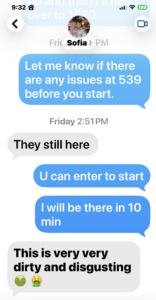
The smell of urine was overwhelming — even with all windows open.
The damage included:
Urine-stained hardwood floors
Holes in walls
Damaged kitchen countertops
A completely ruined sofa
Broken chairs
Heavy pest presence (gnats and roaches)
Severe odor saturation throughout the property
- Bed bugs and urine stains in two mattresses which had to be removed
In four years of hosting, we have never had a property returned in this condition.
Check out all the video and photos. I must warn you, it is pretty bad.
The damage is $20,000. Additionally, the property will likely be offline for a month, costing another estimated $4,000 in lost bookings.
What Happens Next
We are documenting everything thoroughly — photos, video, invoices — and submitting a damage reimbursement request through Airbnb’s AirCover program.
The final financial impact will depend heavily on how much Airbnb reimburses, both for damages and potential loss of income.
Was It Worth It?
At this point, it’s too early to say.
The total revenue was strong. But if reimbursement falls short, the long-term cost — financially and operationally — could outweigh the gain.
Lessons Learned
After nearly 25 years in real estate investing, I am still surprised by how some people live. Seriously, I just can’t imagine the living conditions for some folks and they think it is perfectly normal and acceptable, which really blows my mind.
But as investors, surprise is not a strategy.
Here are the key takeaways:
Cash flow alone cannot justify risk.
High monthly revenue should never override strong underwriting standards — especially with pets.Pet policies must be extremely strict.
Four dogs in a furnished home for six months is not a small risk — it’s a commercial-level liability.Quarterly inspections may not be enough.
For mid-term stays with pets, more frequent walkthroughs should be written into agreements. Mandatory monthly cleanings must be included.Insurance-backed bookings still require scrutiny.
Just because a guest is placed by an insurance relocation company does not mean the property will be protected.Have reserves for worst-case scenarios.
Even experienced operators will face outliers. The key is absorbing them without destabilizing the property.
Mid-term rentals remain one of our most effective slow-season strategies. The Vista proves that. The Argonne reminds us that every strategy carries risk.
As investors, our job is not to avoid risk — it’s to price it correctly, manage it proactively, and protect the downside.
I’ll keep you posted on how Airbnb responds.