

January 19, 2026 | 2.5 Minute Read
It’s been about four years since we launched our first short-term rental on Airbnb and VRBO, and in that time, I’ve learned more than I ever expected. Short-term rentals are not passive income. They are operational businesses, and without strong systems, they will expose every weakness in your process.


Over the past four years, we’ve scaled our portfolio as high as 18 short-term rentals and, about 2 years into hosting, made the intentional decision to downsize to our current number of 8.
That contraction wasn’t a failure—it was refinement. It gave us the opportunity to analyze performance, eliminate inefficiencies, and stress-test our systems. Today, we have the experience, data, and operational clarity to confidently begin adding properties again.
Short-Term Rentals Are a Systems Business
The biggest misconception about short-term rentals is that success comes from picking the “right” property or market. In reality, success comes from repeatable systems. Without them, scaling simply magnifies chaos.
Over time, we built and refined systems for:
Guest communication and response time
Cleaning coordination and quality control
Maintenance triage and vendor management
Dynamic pricing and occupancy optimization
Turnover logistics and calendar management
Platform diversification beyond Airbnb and VRBO to mid terms, direct booking and booking.com
Each of these systems had to work independently and together. If one breaks, the entire operation feels it immediately—through bad reviews, missed bookings, or increased stress on the team.
Downsizing Was the Best Thing We Did
Running 18 STRs taught us where volume helped and where it hurt. Not all properties are worth the management bandwidth. Some required outsized attention relative to their return, and others exposed gaps in our processes.
By downsizing to 8 properties, we were able to:
Identify underperforming units and exit them. The 3 bedroom/1 bath properties simply did not perform as expected.
- Standardize operating procedures
Reduce management friction
Improve guest experience and review consistency
Measure profitability per unit, not just gross revenue
This phase gave us clean data and honest feedback on what actually worked.
What did we do with the properties that did not perform? We converted several back to long term rentals, sold a few retail because of the amount of equity available to cash out, and off loaded others to turnkey investors.
Continuous Evaluation Is Non-Negotiable
Even with solid systems in place, nothing is ever “set it and forget it.” We evaluate performance monthly—pricing, occupancy, guest feedback, maintenance costs, and platform mix. Markets shift. Regulations change. Guest behavior evolves.
That constant review is what allows us to adapt without panic and make decisions based on numbers instead of emotion.

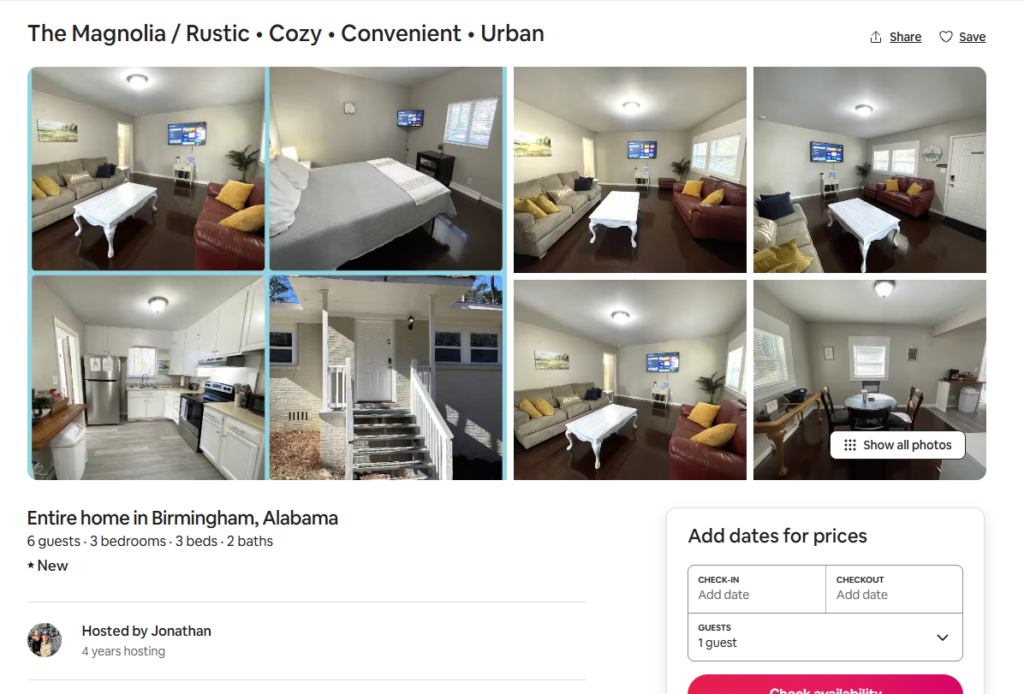
So, here we have the Magnolia. I provided a link to Airbnb above. It’s a 3 bed/2 bath house and we know it will perform well.
How do we know? Well, it sits directly across from another STR that has been operational for 3/5 years and is identical. We anticipate a projected gross revenue of between $36,000 to $41,000 with a net of $22,000.
Why We Decided to Add Another STR
After roughly two years of operating a leaner, more efficient portfolio, the data is clear: our systems are working. Not perfectly—but predictably. That predictability is what makes growth possible.
We’re adding another short-term rental not because we’re chasing scale, but because:
Our current operations can absorb it
The processes are documented and repeatable
The unit meets strict performance criteria
The marginal effort to add one more property is now low
This isn’t growth for the sake of growth. It’s controlled expansion backed by experience, discipline, and operational confidence.
The Takeaway
Short-term rentals reward operators, not amateurs. If you don’t understand your systems, your systems will control you. Scaling only makes sense once the business runs smoothly at a smaller size.
We didn’t add another STR because it sounded exciting. We added it because the groundwork was already done.