

August 17, 2026 | 4 Minute Read
Last Thursday, I had another closing scheduled for the sale of an investment property owned by the hedge fund I represent.
The appraisal came in earlier in the week exactly at the purchase price, so I thought we were all set to close.
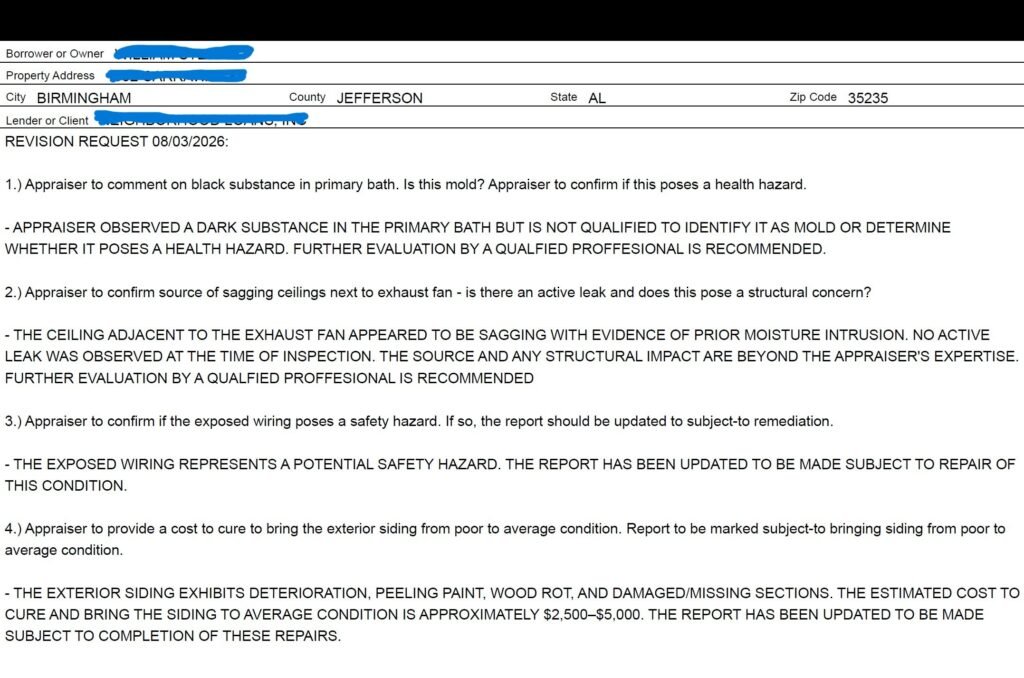
Then I read the appraiser’s additional comments about the property’s condition.



And suddenly, the closing was in jeopardy.
It’s an As-Is Investment Property
This property is being sold as is. It’s an investment property being purchased with conventional financing on a 30-year loan, and the buyer plans to renovate and keep it as a rental.
Apparently, the appraiser felt compelled to comment on several issues he observed at the property.
Those comments ultimately became a problem for the lender.
The appraiser identified what he considered to be:
- A “structural issue”
- A “mold issue”
- An electrical issue
- A siding issue
.
Let’s take a closer look.
The “Structural Issue”
The structural issue was related to old drywall that needs to be replaced.
There was no indication that the house was actually experiencing a structural failure. The drywall simply needs to be removed and replaced as part of the renovation.
The “Mold Issue”
The mold issue was even more interesting.
The previous tenant apparently did not hand-scrub the showers before moving out.
Anyone who has owned rental properties knows exactly what this can look like. A dirty shower can develop discoloration and surface growth that may look alarming in a photograph but does not necessarily mean the property has a significant mold problem.
Nevertheless, it was flagged.
The “Electrical Issue”
Then there was the electrical issue.
The concern was that several electrical faceplates needed to be screwed into place.
And, as an added bonus, the appraiser apparently considered the phone wiring to be an electrical concern.
Apparently, low-voltage telephone wiring is extremely dangerous.
I guess it will kill you if you hold onto it directly for five or ten years.
I’m kidding, of course.
But this is where I started questioning whether we were getting outside the scope of an appraisal.
The Siding
The siding issue was the one item I actually agreed with.
The siding needs to be replaced.
That’s not really debatable.
However, the appraiser went a step further and estimated that replacing it would cost somewhere between $2,500 and $5,000.
That’s where I have a problem.
Is estimating renovation costs part of an appraiser’s job?
Is this appraiser also an investor?
Has he personally renovated investment properties?
Is he a licensed general contractor?
The answer to all is no.
An appraiser’s job is to provide an opinion of value—not to provide a contractor’s estimate for renovating the property.
The Appraiser Wasn’t the Only Issue
The lender had the right to select the appraiser.
In this case, the lender selected him.
That’s their right.
But I made a mistake when the appraiser called to schedule the appointment.
I assumed he already understood exactly what he was walking into.
I shouldn’t have assumed that.
I should have explained that this was:
- An investment property
- Being sold strictly as is
- Being purchased by an investor
- Going to be renovated after closing
- Intended to remain a rental property
- Being financed with a conventional 30-year loan because the buyer wanted a lower interest rate than typical hard-money financing
.
I didn’t have that conversation with him.
I know better now.
And you can bet I’ll be having that conversation on future transactions.
The Lender Wants the Repairs
Once the appraisal raised these issues, the lender now required the items to be addressed before closing.’
Why? Because it is a conventional lender. Had it been a hard money lender, this would not have been an issue.
That created a problem.
The hedge fund wasn’t going to make the repairs.
Why?
Because this was clearly marketed and contracted as an as-is sale.
The buyer understood that when he made his offer.
The property was priced accordingly.
So the buyer made a decision I probably would not have made.
He sent his contractor to the property and had these repairs completed himself.
Over the weekend.
Would I Have Done the Same Thing?
Probably not.
And there is a very simple reason.
I don’t own the property.
The buyer is spending his own money to make improvements to a property he doesn’t own yet.
What happens if the transaction doesn’t close?
He’s potentially out the thousands of dollars he spent on repairs.
That’s a risk I wouldn’t be comfortable taking.
I understand why he did it, though.
He wanted the property.
He wanted the financing.
And he didn’t want an appraisal issue to derail the transaction over a handful of relatively minor repairs.
Sometimes getting a deal closed requires making decisions that aren’t necessarily ideal.
What Happens Next?
The appraiser is scheduled to return to the property today, Monday, August 17, to verify that the repairs have been completed.
Assuming everything is acceptable, the appraiser will update the report and remove the items that were holding up the loan.
As for the closing, both parties already agreed to extend the closing date to August 26.
Hopefully, that’s the end of the story.
But there is a lesson here that I’m taking with me into every future investment-property transaction:
Never assume the appraiser understands the deal.
If you’re selling an investment property in as-is condition, make sure the appraiser understands exactly what the property is, how it is being sold, and what the buyer intends to do with it.
A property that looks rough to an appraiser may be exactly what an investor intended to buy.
And sometimes, failing to communicate that distinction can turn a perfectly good appraisal—and a perfectly good deal—into a closing problem.