
March 2, 2026 | 4 Minute Read
We have worked with Section 8 tenants in Birmingham for over 15 years. Locally, there are three housing authorities that administer vouchers: Housing Authority of the Birmingham District (HABD), Jefferson County Housing Authority (JCHA), and Bessemer Housing Authority (BESH).

HABD is by far the largest, and roughly 75% of our Section 8 inquiries come through them.
Over the years, we’ve developed a straightforward onboarding process:
Our Section 8 Onboarding Process
A prospect contacts us and we schedule a showing.
If they want to move forward, they provide a completed Request for Tenancy Approval (RFTA) package.
The prospect submits an application, and we run credit and background checks. If they meet our standards, we approve them.
We submit the completed RFTA to Section 8 with the requested rental amount.
Section 8 issues a Maximum Rental Amount letter. If the terms work, we sign and return it.
The property is inspected. Because our homes are fully renovated, we consistently pass inspection.
Section 8 re-certifies the rent and may issue a revised Maximum Rental Amount letter — which has always been the same or higher. We sign and approve.
Once approved, the tenant signs the lease and moves in.
From start to finish, the process typically takes four to six weeks. It may seem like a lot of steps, but once you understand the system, it runs smoothly.
Two Recent HABD Leases
Our last two Section 8 tenants we onboarded through HABD. We began the process in October, received final approval in December, and both tenants moved in on January 1, 2026.
Here were the terms:
4 bed / 2 bath – South East Lake
Approved rent: $1,647
Tenant pays: $715
HABD pays: $9323 bed / 1 bath – Center Point
Approved rent: $1,422
Tenant pays: $666
HABD pays: $756
These were standard approvals, and both properties followed the same process.
The HAP Contract Issue
One critical detail many landlords overlook: even after the lease is signed and Section 8 approves the rent, you must still receive a signed Housing Assistance Payments (HAP) contract from the housing authority. The HAP contract formalizes how rent is split and how payments will be distributed. Below is the letter received for our 4 bedroom property.
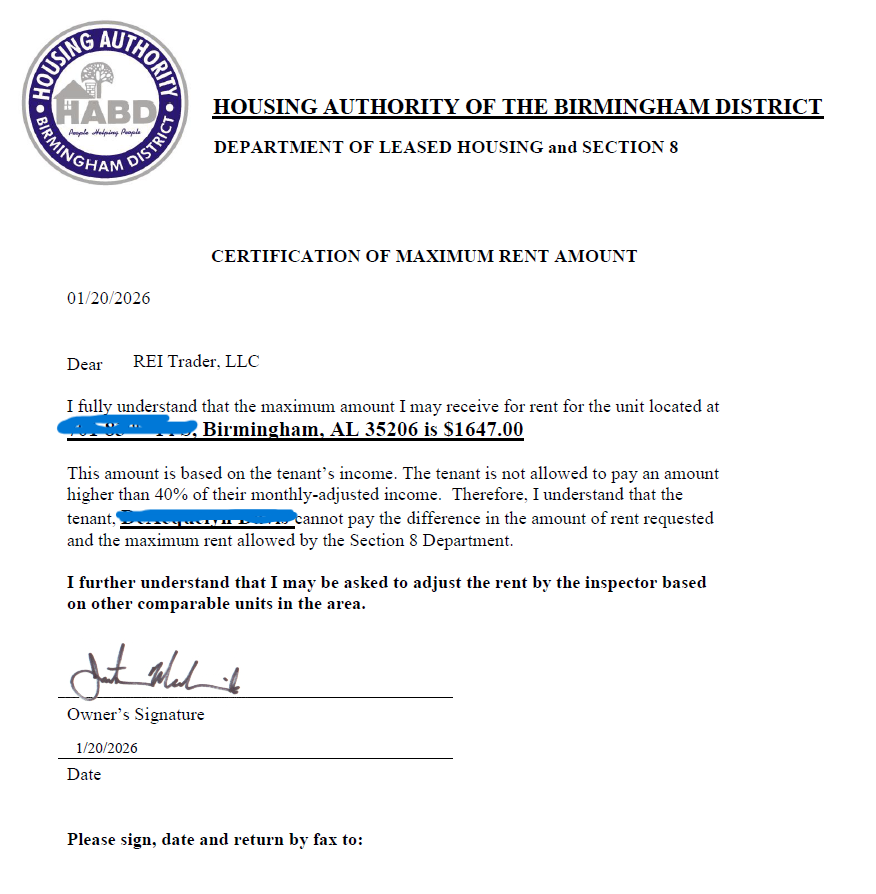
However, HABD will not issue the HAP contract until the tenant has physically moved into the property. It’s a classic chicken-and-egg situation: no move-in without approval, but no HAP contract until after move-in.
In the meantime, the tenant pays their portion of the rent, and we wait for the signed HAP contract so HABD can release payment retroactively to the lease start date. Historically, this has always been a formality. Once the HAP contract is signed, arrears are paid in the next monthly distribution.
The Unexpected Reduction
Two months after move-in, instead of receiving the HAP contract for the 4-bedroom property, we received a new Maximum Rental Amount letter.
HABD informed us they had adopted new payment standards effective January 1, 2026. According to their notice, most Jefferson County zip codes saw decreased payment standards. Because this lease began after January 1, they recalculated the tenant’s affordability under updated guidelines.
HUD rules require that an assisted tenant’s initial lease cannot exceed 40% of their adjusted monthly income. Under the new standards, the unit was deemed unaffordable at the previously approved rate.
The new maximum rent?
$1,419.
That is $228 less than the $1,647 they had already approved — twice — before the tenant moved in.
The tenant had already been living in the home for two months.
We were essentially told the new rent was non-negotiable and based strictly on HUD policy. If we declined to accept it, we were instructed to notify them.
The Practical Reality
Here’s the real problem: once a tenant is in place, the leverage shifts.
If we refuse the new rate, HABD will likely instruct the tenant to find another property. Removing the tenant becomes our responsibility — not HABD’s. That process can take months, especially if the tenant cannot afford the full rent without assistance.
In 15 years, this has never happened to us. Payment standards have changed before, but never retroactively after approval and move-in.
I responded firmly. From experience, I know pushing too hard rarely changes the outcome. Still, we plan to:
Speak with the tenant to understand whether their income changed.
Attempt to escalate the matter to the HABD director.
Realistically, however, options are limited.
And what about the 3-bedroom property? Given the timing and payment standard changes, we fully expect the same recalculation may occur.
Where This Leaves Us
At the end of the day, our recourse appears limited. Legally and practically, the housing authority holds the administrative power. While the program provides stability and guaranteed payments in many cases, this situation highlights the risk of relying on payment approvals before receiving a fully executed HAP contract.
As a result, we have already begun reevaluating our intake strategy. We recently turned away four HABD prospects on three available properties. That is not a decision we make lightly, but we will no longer work with HABD. When approved rents can be reduced after move-in, it introduces a level of uncertainty that is difficult to underwrite.
Section 8 can be an excellent program for landlords who understand the system. However, experiences like this serve as a reminder: policies change, standards shift, and until the HAP contract is signed and finalized, nothing is truly guaranteed. For investors, the key lesson is simple — protect your numbers, anticipate administrative risk, and never assume an approval is final until the paperwork is complete.
In the meantime, we will continue to work with JCHA and BESH. However, if they pull the same stunt, our days working with Section 8 will come to a close.