November 9 2026 | 6 Minute Read
I’ve been a real estate investor for almost 25 years. When I first started wholesaling in Fort Lauderdale back in 2002, finding and closing deals was a lot simpler. Most of my deals came from an email list and good old-fashioned door knocking. There were no Facebook groups, robocalls, or sophisticated skip-tracing services. Even the MLS wasn’t available on the Internet.
Sometimes I feel like a dinosaur when I think about how much things have changed.
Back then, there were plenty of deals, relatively little competition, and a healthy pipeline of closings every week. Today, things are considerably different. Technology has advanced at an incredible pace, particularly with artificial intelligence. Unfortunately, that technology isn’t just helping legitimate businesses. Scammers are using it to become increasingly sophisticated, making it harder to distinguish legitimate communications from fraudulent ones.
And that’s something every real estate investor needs to pay attention to.
Business Is Good, But So Are the Scammers
Despite mortgage rates exceeding 7%, I’m still closing deals every week. In last week’s newsletter, I discussed why higher interest rates are creating opportunities for real estate investors. I’m seeing that play out firsthand with my own closings.
As the exclusive listing agent in Birmingham for one of the country’s largest hedge funds, which owns more than 11,000 properties, I’ve been selling all of its listed properties in less than 90 days. Most have sold to other investors, but several fully renovated properties have also sold to retail buyers financing their purchases with mortgage rates in the 7.5% range.
Weekly closings have become the norm for me.
Coordinating these transactions with closing attorneys, title companies, buyers’ agents, and sellers is a routine part of the business. However, keeping everything organized and making sure the details are handled correctly requires constant attention.
One routine part of the process is receiving emails from closing attorneys and title companies asking me to log into their portals to review documents or verify transaction information.
I receive so many of these emails that I’ve developed a habit of quickly scanning them, finding the link, and clicking through so I can move on to the next task.
That’s exactly what makes this type of scam so dangerous. It takes advantage of familiar routines and the assumption that an email from someone involved in a transaction is legitimate.
The Email That Almost Fooled Me
Last week, I received an email that appeared to come from a closing attorney. At first glance, it looked completely legitimate. In fact, it was nearly identical to the emails I’ve received from title companies on previous transactions.
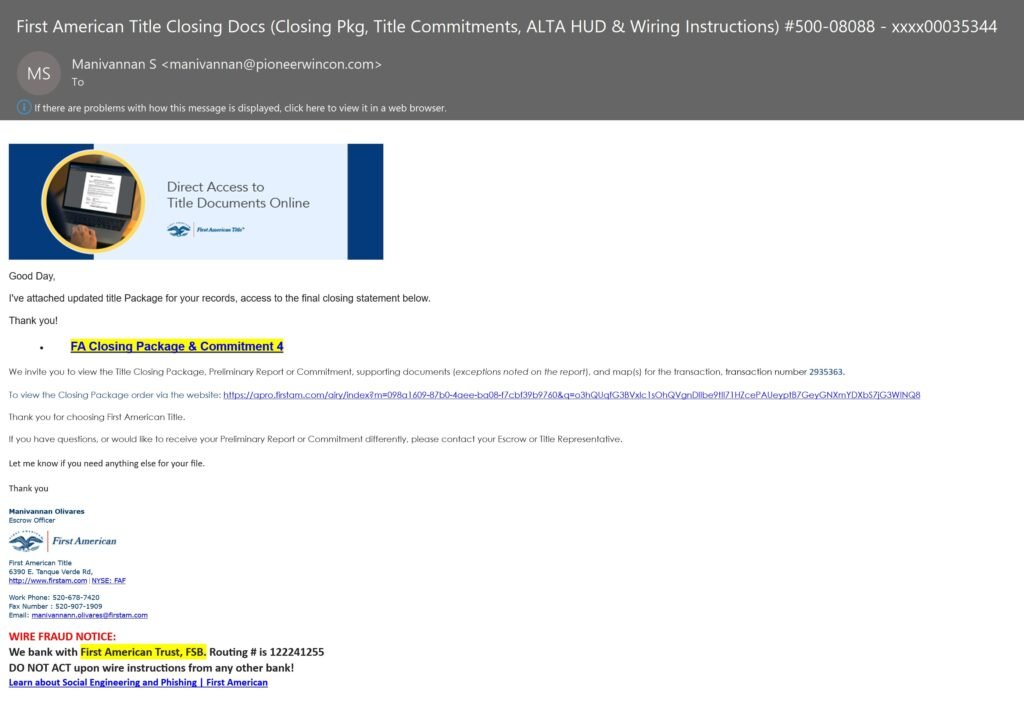
First American Title is actually handling the closing of one of my properties scheduled for November 10. So, receiving an email requesting that I verify information through its portal wasn’t unusual.
I was just about to click the link when something didn’t look quite right. Instead of immediately clicking through, I stopped and took a closer look at the email.
That extra minute may have saved me a considerable amount of trouble.
The Red Flags I Almost Missed
After examining the email more closely, I noticed several things that didn’t add up.
1. The Email Address Was Subtly Different
The email signature listed the following address:
manivannann.olivares@firstam.com
Look closely at the spelling of the name. There is an extra “n” compared to the expected spelling of the employee’s name.
This is a common tactic used in phishing attacks. Scammers frequently use email addresses that look almost identical to legitimate ones, hoping recipients won’t notice a minor spelling difference.
Even when an email appears to come from a legitimate corporate domain, you shouldn’t automatically assume it’s authentic. Email addresses and sender information can be spoofed, and a familiar-looking domain doesn’t guarantee that the message actually originated from the company.
2. The Phone Numbers Didn’t Match the Office
The signature included a physical address:
6390 E. Tanque Verde Rd., Tucson, AZ.
The address appeared to correspond to a legitimate First American Title office operating locally as Title Security Agency. However, the publicly listed phone number for that office was (520) 885-1600.
The email signature listed two different numbers:
(520) 678-7420
(520) 907-1909
Why would an employee representing that office provide phone numbers that didn’t match its publicly listed contact information?
That was another warning sign.
Scammers can use burner phones, virtual phone numbers, and other services to make fraudulent communications appear legitimate. Never assume a phone number in an unsolicited email signature is safe to call.
3. The Link Didn’t Look Right
Another suspicious detail was the URL associated with the email, which referenced http://square.site.
This was concerning because I was expecting to access a title company’s secure portal, not an unrelated website.
The combination of an unusual link, questionable contact information, and the suspicious email address stopped me in my tracks.
At that point, I knew someone was impersonating First American Title in an attempt to obtain sensitive information.
I Contacted the Title Company Directly
Rather than replying to the email or clicking the link, I contacted the title company separately using contact information I already knew was legitimate.
I sent them a screenshot of the suspicious email and asked them to verify whether it was authentic. I intentionally avoided forwarding the original email because I didn’t want anyone inadvertently clicking on the suspicious link.
As I suspected, the title company confirmed that the individual was not employed by First American Title and that the email was fraudulent.
About five minutes later, I received a phone call from the title company reiterating that I should take no action on the email and delete it.
Fortunately, I caught it before clicking anything.
And, wouldn’t you know it. About an hour later, I received another scam email, this from a different title company.
Now, I never clicked on any link from the previous email scam but apparently my brokerage email is on these list of scammers unfortunately.
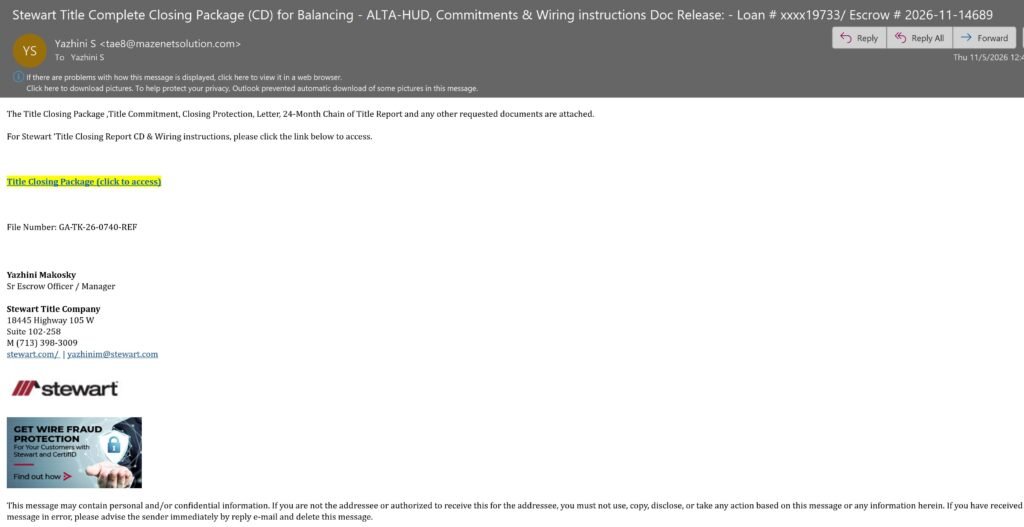
But here’s the bigger issue: How many real estate investors, agents, sellers, and buyers are receiving emails just like this every day and clicking without thinking twice?
Real Estate Fraud Is a Growing Problem
Unfortunately, this isn’t an isolated incident.
According to an FBI report covering 2025, the agency received 12,368 complaints involving real estate-related fraud, with reported losses exceeding $275.1 million.
That’s a huge amount of money being lost to fraudulent activity.
Source: FBI Cybercrime Losses: Real Estate Fraud Hits $275M
And email phishing isn’t the only threat.
A September 2026 CNN report highlighted an even more disturbing example involving two homebuyers who reportedly lost $66,000 in a suspected voice-cloning scam.
Think about that for a minute. With artificial intelligence, scammers can potentially imitate someone’s voice and use that technology to convince buyers to send money to fraudulent accounts.
Source: CNN: ‘We Both Missed the Signs’: How Two Homebuyers Lost $66,000 in a Suspected Voice-Cloning Scam
The days of receiving an obviously fraudulent email filled with spelling mistakes and suspicious grammar are quickly disappearing. Today’s scams can look, sound, and feel legitimate.
Best Practices to Protect Yourself From Real Estate Scams
Whether you’re an investor, wholesaler, real estate agent, property manager, or someone buying or selling a home, there are several precautions I recommend making part of your everyday business practices.
1. Never Trust an Email Just Because It Looks Legitimate
Pay attention to the sender’s complete email address, not just the display name. Look for subtle misspellings, extra characters, unusual domains, and unexpected changes in communication.
Remember, even a legitimate-looking email address can be spoofed.
2. Never Click Links Without Verifying Them
If a title company, lender, attorney, or other business asks you to log into a portal, don’t automatically click the link.
Instead, hover your mouse pointer over the link (without clicking it) to view the URL and confirm it’s coming from the title company’s or closing attorney’s website.
3. Independently Verify Wire Instructions
This is probably one of the most important precautions in any real estate transaction.
Wire fraud is particularly dangerous because scammers frequently impersonate closing attorneys, title companies, and other transaction participants.
If you receive wire instructions by email, independently verify them by calling a previously established, trusted phone number. Never rely on a phone number included in the email containing the instructions.
If wire instructions change at the last minute, treat that as a major red flag.
4. Establish a Verification Procedure With Your Closing Attorney
Don’t wait until closing day to figure out how you’ll verify sensitive information.
Establish a procedure with your closing attorney or title company at the beginning of every transaction. Confirm the correct contact information, preferred communication methods, and procedures for handling wire transfers and changes to payment instructions.
5. Be Careful With Unexpected Phone Calls and Voice Messages
AI-generated voices can make fraudulent calls sound remarkably convincing. If someone calls requesting money, account information, or changes to transaction instructions, don’t assume you know who you’re speaking with.
Hang up and call the person back using a number you already have on file.
For particularly sensitive requests, consider establishing a verbal verification phrase with trusted business contacts.
6. Use Multi-Factor Authentication
Enable multi-factor authentication (MFA) on your email accounts, financial accounts, and any online portals containing sensitive business or customer information.
Even if someone obtains your password, MFA provides another layer of protection against unauthorized access.
7. Slow Down When Something Seems Unusual
This may be the simplest and most important recommendation.
Scammers rely on urgency. They want you to act quickly, avoid asking questions, and click before you have time to think.
If something feels unusual, stop. Verify the information independently before taking action. A legitimate closing attorney or title company should have no problem with you taking a few extra minutes to confirm a request.