
September 21 2026 | 5 Minute Read
This is a follow-up to my September 7 post, “Why I’m Building a Direct Booking Website.” After about a month of building, testing and troubleshooting, I’m happy to report that BirminghamVacationHomes.com is now live.
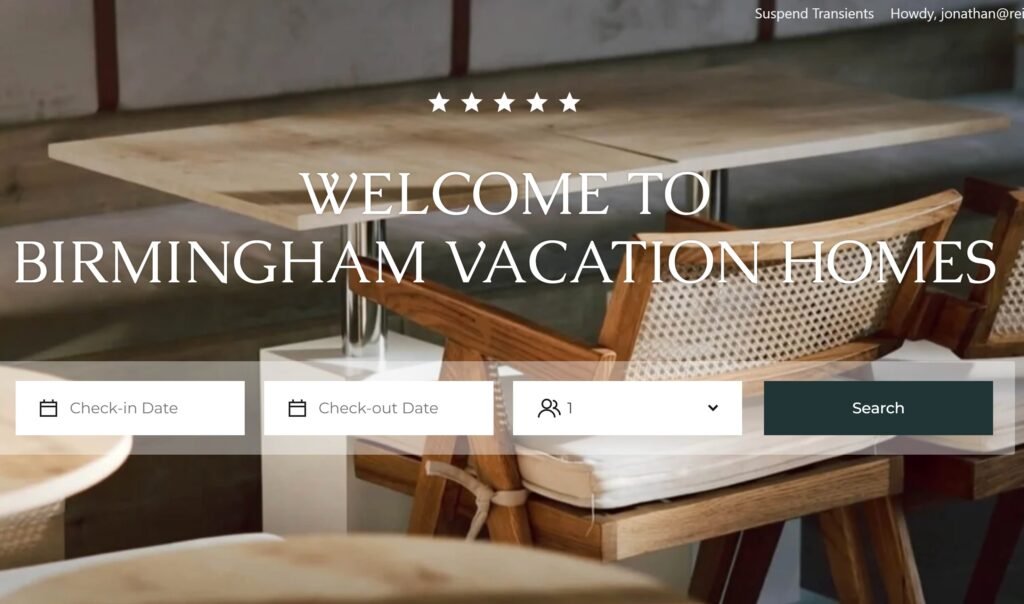
The goal was simple: create another avenue to increase occupancy and reduce our dependence on the major booking platforms.
We already do well with Airbnb and VRBO. Our properties average about 62% occupancy month to month, compared with roughly 50% average for our market.
I’m not trying to replace Airbnb or VRBO. I simply want another way to generate bookings.
After publishing the previous article, I received several emails from other investors and short-term rental operators asking what resources I used to build the site. Since the website is now live, I thought this would be a good time to share exactly what I used.
Hosting
I selected Hostinger for the website hosting. WordPress comes pre-installed, which made it relatively easy to get started.
Since I already use WordPress for REI.School, I was comfortable with the platform and didn’t have to learn an entirely new system.
WordPress
I built REI.School with WordPress, so I already knew how flexible the platform can be.
One of the biggest advantages is the number of plugins available. A WordPress plugin is essentially a software package that adds functionality to your website without requiring you to build everything from scratch.
For this project, that flexibility was important because I needed much more than a basic website. I needed a booking engine, dynamic pricing, payment processing, calendar synchronization and the ability to eventually distribute the properties through Google Vacation Rentals.
The WordPress Plugins
I spent about a week researching different options before deciding what I wanted to use.
Elementor
I used Elementor as the website builder. It provides a drag-and-drop interface that makes it relatively easy to build and customize pages without having to code everything from scratch.
MotoPress
The core of the booking system is MotoPress Hotel Booking. It provides the booking functionality, property management tools, payment integration and calendar synchronization I needed.
MotoPress essentially allowed me to build much of what I was looking for without having to subscribe to a traditional property management system.
MotoPress Booklium Theme
I used the Booklium theme for the front end of the booking website.
The theme provides the basic design and structure for a vacation rental website, while still giving me plenty of flexibility to customize the appearance and functionality.
Accommodation-Based Payments
This was an important one for my business.
Our properties are owned by three separate companies, so I didn’t want all of the booking revenue deposited into one bank account and then have to manually move the money between accounts.
MotoPress’ accommodation-based payment functionality allows me to configure properties to use different Stripe accounts.
That may sound like a minor detail, but it makes a big difference from an accounting standpoint.
PriceLabs Integration
Dynamic pricing is another critical component.
We use PriceLabs to adjust our nightly rates based on demand and other market factors. Integrating PriceLabs with the website means I don’t have to manually enter a different price for every property and every night.
I’m definitely not doing that.
iCal Calendar Synchronization
Avoiding double bookings is obviously a priority.
The iCal synchronization allows the website to communicate availability with Airbnb and VRBO calendars. MotoPress supports importing and exporting calendars with platforms that use iCal synchronization.
That means when a property is booked through one channel, the availability can be reflected on the others.
It’s not something I want to have to monitor manually.
Google Vacation Rentals
Google Vacation Rentals was one of the biggest reasons I decided to build the website myself.
I want our properties to have another source of exposure outside of Airbnb and VRBO. As I discussed in my previous article, I initially thought the only way to get our properties onto Google Vacation Rentals was through an approved property management or channel-management system.
That turned out not to be entirely true.
MotoPress operates more like a content management system for the website, while also providing the booking functionality and channel connectivity I need. As part of the launch process, I submitted six of our nine properties to Google Vacation Rentals.
Hopefully, they will begin appearing there shortly.
Three of our properties are currently disabled because we have mid-term guests staying for several months. Those guests often extend their stays, so I need to keep those calendars available rather than actively marketing the properties for short-term bookings.
I also discovered that disabling a property may affect how it appears in Google Vacation Rentals, so I’m still working on a solution for that.
Payment Processing
WordPress and MotoPress integrate with Stripe for payment processing.
Again, the ability to use multiple Stripe accounts was important because our properties are owned by three different companies.
Without that functionality, all of the booking revenue would initially flow into one account and then have to be distributed to the other companies.
That would create an unnecessary accounting headache.
Security Deposits
I wanted the ability to place a $1,500 hold on a guest’s credit card at the time of booking and then release it after checkout, assuming there were no damages or other issues.
That’s when I found PayRequest.
Once a guest confirms a direct booking, they receive a confirmation email with a payment link to submit the $1,500 deposit. After they check out and everything is in good shape, I simply release the deposit back to them.
The best part is that if I release the entire deposit, there is essentially no cost to me. If I need to keep some or all of the deposit because of damages, PayRequest charges a small fee, along with the Stripe transaction fee since PayRequest integrates with Stripe.
For example, if I had to keep the entire $1,500 deposit to cover damages, my total transaction fees would be approximately $68.
For me, this has been a gamechanger for direct bookings. Without some type of security deposit or damage protection, how do you actually get reimbursed when a guest damages your property?
This gives me another layer of protection while allowing me to offer guests the same basic concept they’re already familiar with: a temporary deposit that is returned when they leave the property in good condition.
AI Made This Possible
One of the biggest differences between building this website today versus doing it several years ago is AI.
I used both Google Gemini and ChatGPT extensively throughout the project.
Whenever I ran into a technical problem, I could explain what I was trying to accomplish and ask AI for help. In many cases, it gave me the code and explained exactly where to put it.
That was particularly useful with MotoPress customization involving CSS, JavaScript and PHP.
For example, I wanted to integrate our Vacation Rental Innkeeper Agreement into the checkout page, and have the guest acknowledge this before booking. Using the PHP code generated from Gemini made that possible.
I also used AI to help configure Microsoft Outlook email and Stripe.
Stripe, in particular, can get complicated quickly. Having AI walk me through the configuration was a huge help.
What About MotoPress Support?
I did use MotoPress support once, but I quickly realized I didn’t want to depend on it for every question.
I emailed support with a specific question about setting up the Booklium theme. It took two days to get a response, and they don’t provide support on weekends unless you purchase additional support.
I’m not saying their support is bad. It’s simply not the way I wanted to build this project. Relying on them for support and their response time would have taken me twice as long to build the website.
With AI available, I could get an answer immediately and continue working rather than stopping the project and waiting for a support ticket.
Why Didn’t I Just Hire a WordPress Designer?
I could have.
But I estimated that having someone build this website for me would probably cost somewhere in the $5,000 to $7,500 range.
Then I’d have to document everything I wanted, explain the business model, communicate changes, review the work, request revisions and coordinate with someone who may be working in a different time zone.
And it would have taken three times longer to complete.
There is another reason I decided to do it myself.
I actually enjoy figuring this stuff out.
I’m busy running the business, but one advantage I have is that I’m up at 4 a.m. every day.
Not by choice.
My 12-year-old Beagle wakes me up at this time every day and needs to go outside and take care of business.
Once I’m up, I usually have about five hours before I transition into my regular real estate activities.
Instead of spending that time checking email or other things, I can work on projects like this.
Was It Worth It?
That’s probably the biggest question.
The website isn’t going to magically produce bookings just because it’s live. Now comes the harder part: getting people to use it.
That means the next step is to do a deep dive into SEO.
I still need to market the website, generate traffic, encourage past guests to book directly and figure out what incentives will make direct booking attractive enough to compete with the convenience of Airbnb and VRBO.
But that’s exactly why I wanted to build it.
After more than four years in the short-term rental business, I have learned that I don’t want to be completely dependent on someone else’s platform for access to my guests.
Airbnb and VRBO are still important parts of our business, and I’m not walking away from them. But having our own booking website gives me another channel, another relationship with the customer and ultimately more control over how we operate the business.
The website is live. Now the real experiment begins: Can I turn the traffic we generate into direct bookings and gradually reduce our dependence on the OTAs?
That’s what I’ll be watching over the next several months.